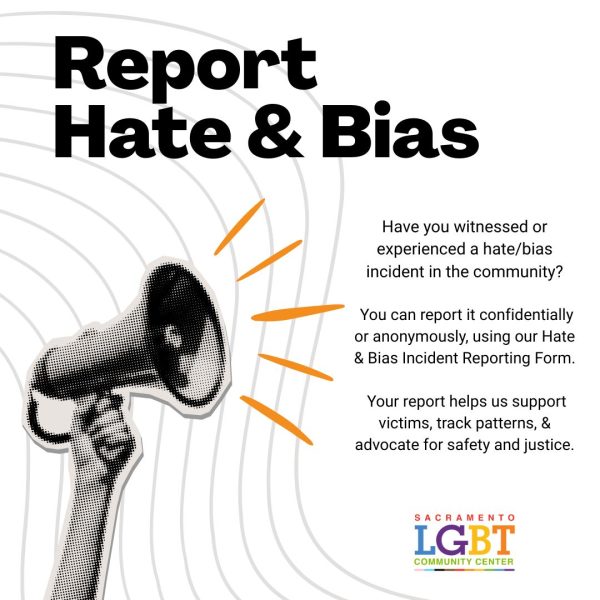
If you are a victim or witness of hate or bias incidents please complete our Hate and Bias Incident Reporting form here. All reports will be kept confidential to the extent possible. When you submit a report, you can choose whether to share your contact information or remain anonymous.
Confidential: You provide your name or contact info, and our staff will keep your identity private. This allows us to follow up with you, offer support, and help you navigate next steps—your information will not be shared without your permission (unless required by law)
Anonymous: You do not provide any identifying information. We won’t know who you are, but your report still helps us track incidents and advocate for community safety.
Both options are valid—choose what feels safest for you.
This form is intended to provide a community friendly tool for people to report incidents of hate, bias, discrimination, or complaints of police violence. With this information, Center staff can follow up with the individuals involved to provide support, track incident data, provide assistance in filing reports with law enforcement and act as an advocate and liaison on behalf of victims.
What is a hate crime? A hate incident is an action or behavior motivated by hate but legally protected by the First Amendment right to freedom of expression. Examples of hate incidents include name-calling, insults, distributing hate material in public places, and displaying hate material on someone’s own property. If a hate incident starts to threaten a person or property, it may become a hate crime.
A hate crime is an offense based on the victim’s color, race, national origin, gender, sexual orientation, religion, age, ancestry, or disability. A hate crime is any crime committed because of these factors, or a victim selected because of these factors. Examples include physical assault, stalking, criminal threatening, vandalism, verbal abuse, and reckless conduct.
Bias incidents are statements that are offensive or racist but are not illegal. These incidents are types of prejudice that are not criminal offenses because legislators have decided not to criminalize them, or because they are protected under the First Amendment. Examples include hate speech, religious slurs, sexist jokes, offensive graffiti, or remarks on social media.